
George Baxter 1863 - 1864
Following on from my articles on Baxter’s 1860 retirement auction sale at Southgate & Barrett (S&B) , his travelling regional sales 1860-63 along with the associated articles of a sale poster dated February 1863 and an advertising poster for the sale in Bristol in May 1861 and where was George Baxter in 1862? I now move on to the period 1863 – 1864.
After the S&B sale Baxter spent the next three years disposing of his vast stock of prints over, at least, 41 regional sales throughout the UK, some lasting many days. In early 1863 he again thought about disposing of his plant and the ‘Illustrated London News’ of 10th January 1863 states “The Plant of Oil Colour Picture Printing – Mr George Baxter the Inventor and Patentee of this beautiful process having retired from his artistic labours is now disposed to part with his valuable plant – For particulars apply by letter to Mr Vincent Davis, Westbourne Hall, Westbourne Grove, London”. This address appears to be the address of the then newly built 'Bayswater Athenaeum & Club'.

‘Illustrated London News’ of 10th January 1863
Vincent Davis had been employed by Baxter for, at least, the greater part of the last three years as his name appears in a high proportion of the adverts for the regional sales. On the 13th July 1863 Baxter advertised “Mr Baxter has been obliged to discontinue his sales by auction in consequence of the injury of his manager and auctioneer, Mr Davies (Sic), sustained by the unfortunate Railway Accident at Wolverhampton on Monday last”.

The Birmingham Daily Gazette - July 13 1863 - courtesy British Newspaper Archive
Only one more sale took place in Weston Super Mare in August 1863, presumably booked in some time beforehand, before Baxter gave up this method of sale completely.
Baxter must have greatly relied on Davis, we know from Baxter’s days working in his father’s businesses in Lewes and Brighton that he didn’t enjoy working ‘front of house’ dealing with customers, much preferring to spend his time sketching. Although Baxter attended a good number of his sales he most probably spent his time finding, booking and advertising the future sales venues whilst still finding time to indulge his love of sketching. Davis’s accident must have left Baxter slightly at a loss as to the best way forward, he obviously didn’t seem to have someone else he could have entrusted to take over Davis’s role and, as I said, it was very unlikely that Baxter himself would have relished taking on the task, yet he still had a vast stock of prints on hand. What should he do now?
As part of the ‘Snelling archive’ of letters relating to George Baxter, copies kindly lent to me by the late Brian Harrild, there is a legal agreement dated 10th December 1863 to mortgage the future benefits of his father’s will. John Baxter had died in 1858 and in his will, made in 1853, his father had bequeathed George £600 and released “him from all sums of money which I have from time to time advance to him…”. A later codicil gave George a further £200 with both amounts to be held in trust and only payable upon the death of Baxter’s mother who did not pass away until 1868 aged 89.
After reading this mortgage a number of times, strangely it appears Baxter borrowed £3,000 from the mortgagee Edward Selle, a grocer from Middlesex, but only appears to be offering as security the £800 from his fathers will. There is obviously something in the mortgage that I cannot see although a reference is made to an indenture dated 24th December 1858 (8 days after John Baxter’s Probate) which if ever found might give us the answer. You can read the full details of John Baxter's will and the transcript of the Baxter/Selle mortgage by following the links.
Apart from borrowing money from his father to fund his growing business over a period up to 1853 this is the first mention I can find of Baxter needing to borrow or raise funds. Presumably this was done to assist his financial situation now that what must have been his main source of income had dried up in August 1863 when he stopped his regional sales. He must now be wondering how he will dispose of the rest of his stock of prints and also his plant all of which SHOULD have easily funded his retirement.
One thing that you might notice with his regional sales is that he didn’t hold any in London or the surrounding areas. I can only surmise that Baxter was, throughout this period, still selling from his London business and didn’t want his regional sales to impact that. An advert dated 3rd January 1863 in the ‘Illustrated London News’ states “New Music – D’Albert’s Prince of Wales Gallop. A new edition. Beautifully illustrated with a portrait (in colours) of HRH the Prince of Wales by Baxter”. Showing he most probably was still selling to the trade around that time.

‘Three years after Baxter 'retirement' yet he is still selling to the trade, a print that was only first published in 1859 as this adverts shows - 'Illustrated London News’ - 3rd January 1863
So what must he do, should he now just rely on his sales from Northampton Square to give him an income for his retirement? He then decides to give a ‘big’ marketing push, Courtney Lewis (CL) in ‘The Picture Printer’ 1924 features a facsimile of “Baxter’s Republication List 1864 – Re-Publishing Baxter’s Celebrated Patent Pictures in Oil Colours. Mr Baxter having offered his plant and business for sale but not having found a purchaser has, at the wish of the trade, re-commenced business…”
I find this wording interesting, ‘re-commencing business’ as, as far as I am concerned and have illustrated in this and past articles, he had never stopped. For many years people, including myself, mistakenly believed that Baxter’s regional sales were small in number and of minimal significance making 1864 and this ‘re-commencing business’ with Baxter now reissuing his prints at ‘vastly reduced prices’, a more significant date in Baxter’s history than perhaps it should be.
On his republication issue Baxter applied a label to the back of these prints stating prices, which varied by their size, and then said “Entire series of these highly popular pictures are now in process of re-publishing by GEORGE BAXTER THE INVENTOR AND PATENTEE 12 Northampton Square EC LONDON”. These labels are rare, I can only recall seeing or hearing of about 5 or 6 copies.
The labels were applied to the back of the mount which means if any of these prints are framed or have had their mounts trimmed the labels would now have disappeared or not be visible so there surely must be more although still very few.
A Baxter 1864 republication label on the back of a copy of Baxter's Circassian Lady at the Bath showing how a trimmed mount could easily lose the labels completely

CL states that none of the re-issue appeared on stamped mounts. I believe that CL thought this as all the labels seen are on plain mounts. With the many thousands of prints Baxter must have still had in stock some surely must have been on stamped mounts, and on those, labels would not have been necessary to mark them as Baxter's work. By this time Baxter may have sold his three embossing presses, something that would have been useful to any number of businesses, or perhaps, not having the labour, applying untitled paper labels was much easier than embossing his seal and all the differing titles to the mounts.
It has been said that Baxter missed off some of the colour blocks to this 1864 re-issue. Using ‘I Don’t Like It’ as an example, a copy with an 1864 label was compared to another and a colour block had been omitted or changed. It was also then stated that this could have happened at any time in the 10 years since it was first published.
As previously mentioned, apart from perhaps a small amount of very popular prints that he needed to ‘balance’ his stock volume I feel only a minimal amount, if any at all, were printed at this time. I feel the term re-publishing was just a marketing exercise rather than any major print run. If it was not for CL printing the re-publication list, which I believe is now lost, in his 1924 book and the very few number of prints with labels that exist it might have gone virtually unnoticed.
You would have thought that Baxter would have promoted this venture thoroughly with large adverts in all the main publications like he did on a very regular basis throughout his career (see HERE to see some of those adverts) but no. A search of the Internet and the British Newspaper Archive database reveals only one small three line classified type advert in ‘Illustrated London News’ for 16th April 1864 which stated “Baxter’s Patent Pictures in Oil Colours are now republishing, at 12 Northampton Square, London, and may be obtained at all printsellers”.

The only advertisement I can trace for Baxter's 'big' republication issue - Illustrated London News 16th April 1864
Everyone has acknowledged that this sale was ‘small’ as although, I believe, this April date is the first time any date in 1864 has been attributed to it, it is well documented that Baxter was declared bankrupt in January 1865 so the re-publication would have come to a complete stop at that stage anyway.
There are also other indications that this ‘big’ push was not working as he was again trying to sell his business just two months later but now adding an interesting twist. That he himself would assist for “as long as required”.
The Newcastle Daily Journal of 20th June 1864 states “A valuable plant for sale – To gentlemen who wish to place their son in a good profitable business in which there is no occasion of a previous knowledge of the process as the plant is in good working order. The subjects are well known to the gentlemen of Newcastle being the patented oil pictures of Mr Baxter, a portion of which stock was exhibited and sold at the Academy of Arts Blackett Street (January 21st – 25th February 1862). The amount taken was upwards of one thousand pounds. The Patentee will give his abilities as long as required. For particulars inquire of Mr Baxter, 12 Northampton Square, London or Mr Brough Auctioneer, Blackett Street Newcastle upon Tyne”.
Also a week later the Nottingham & Midland Counties Daily Express of 28th June 1864 has an advert with basically the same wording as above substituting Newcastle and Exchange Hall Nottingham (? – 4th July 1862) for the Academy of Arts.

The Newcastle Daily Journal of 20th June 1864
Also as well as Baxter’s address it gives the address of “Mr J Hunt, Printer and Bookseller, Long Row Nottingham”. This and the previous advert go to show how ‘keen’ Baxter is to actually sell his plant at virtually any cost allowing him to be able to fully retire.
Although I have seen these two adverts, in reality, around this time I would think there could have been a number more. Also worth noting is that the adverts only seem to appear far from London, perhaps Baxter did not want to impact his republication sales which I feel would have been more aimed at his London retail and trade customers.
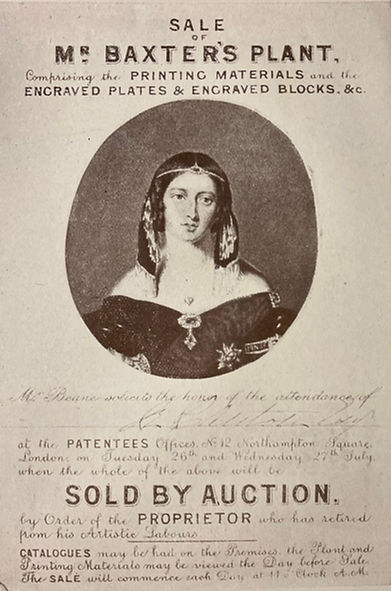
Even these adverts did not seem to attract the desired attention as just the following month we find Baxter again putting his plant up for auction but this time from his own London premises. CL’s ‘The Picture Printer’’ shows an invitation card (wrongly described as the cover of the catalogue) which states “Sale of Mr Baxter’s Plant comprising the printing materials and the engraved plates and engraved blocks &c – Mr Beane solicits the honour of the attendance of…..at the Patentees offices at 12 Northampton Square London on Tuesday 26th and Wednesday 27th July (1864) when the whole of the above will be sold by auction by order of the proprietor who has retired from his artistic labours – Catalogues may be had on the premises the plant and printing materials may be viewed the day before sale. The sale will commence each day at 11 O’clock A.M.” On the card was a copy of Baxter’s Queen Victoria with Headdress cut oval. I assume this is an actual Baxter print in full colour but I have only seen an image of the card in black & white.
An advert in ‘The Times’ of Monday 25th July 1864 states: “To Printers - Mr Beane will sell by auction at the offices, 12 Northampton Square, London tomorrow 26th and Wednesday, 27th July, by order of Mr Baxter the proprietor who has retired from business, the printing materials, the engraved blocks, plates &c, of the patentee of oil colour printing. Catalogues may be had on the premises. The plant and printing materials may be viewed. The sale will commence each day at 11 am. - By Mr Beane, at the premises, on Wednesday 27th at 2 O’clock p.m. Lease (nearly 22 years to run) of the business house and workshops No 12 Northampton Square London”.
This Mr Beane must have been the auctioneer of that name that Baxter had used for some of his early regional sales in 1860. We know this auction wasn’t successful as Baxter holds the plates right up until their sale to Vincent Brooks about a year later.
'Invitation card for auction of Baxter's plant 26th & 27th July 1864 from 'The Picture Printer' 1924'
1865 became the year that Baxter finally ‘succumbed’ and declared bankruptcy, a major feature of Baxter’s life story for the last 130 years. In a future article I will show how the true story is in fact far different to what has been written and hopefully should change perceptions of Baxter’s life completely.